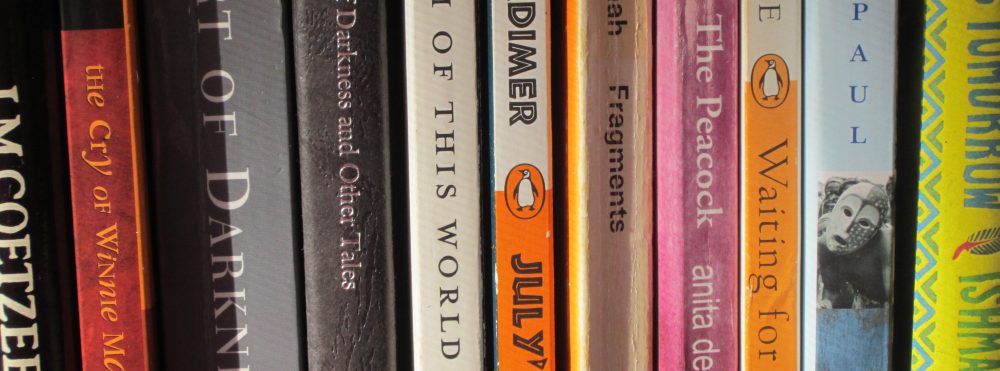
My first book project, Waiting for Now: Postcolonial Fiction and Colonial Time (out now with Edinburgh University Press and winner of the 2020 NeMLA annual book award) argues that the temporal dimensions of waiting are evoked in postcolonial fiction to register protest and resistance to colonial and postcolonial disenfranchisement in the context of colonial historiography, anticolonial nationalist movements, disillusionment, and healing promoted by Truth and Reconciliation Commissions. This project is the first sustained study of waiting in relation to global Anglophone and postcolonial fiction, and contributes to the recent temporal turn in literary studies by arguing that waiting is integral to the experience of colonial and postcolonial temporalities. This scholarship is driven by the following questions: How is waiting configured in relation to colonial regimes of time, to anticolonial nationalisms, to so-called disillusionment after independence, and to promises of closure following Truth and Reconciliation Commissions? How do characters mobilize the language of waiting to describe the limitations and possibilities that inhere in their postcolonial present and conception of the future?
My other publications demonstrate the depth and breadth of my engagement with postcolonial global Anglophone fiction and interdisciplinary approaches to literature. An article published in 2011 indicated my early interest with time and fiction through an analysis of the “meantime” in Nadine Gordimer’s The Pickup. Three subsequent articles also focused on African literature; in Pacific Coast Philology, I analyzed Tsitsi Dangarembga’s Nervous Condition in relation to Friedrich Nietzsche’s philosophy of willing and liberation. In ARIEL, I focused on Nuruddin Farah’s Knots and asserted that state failure discourse in political theory ignores other metrics of success and community organization. In Law, Culture and the Humanities I turned to another Farah novel, Maps, to demonstrate that a more robust law and literature reading of the novel is possible if Somali customary law and its narrative forms are included in the interpretive framework. Several book chapters in edited collections (Transnational Africana Women’s Fictions and Women Writing Diaspora: Transnational Perspectives in the 21st Century) underscore my commitment and interest in Black diasporic and transnational writing across the long 20th century.
Although much of my published work concerns African fiction, I have also published on fiction from other regions. Apart from the article in South Asian Review, I have a article in Anthurium: A Caribbean Studies Journal, where I discuss the narrative forms of film noir that pervade Mayra Montero’s Dancing to ‘Almendra.’ More recently, I published an article in Mobilities on Mohsin Hamid’s Exit West, a book chapter on Louise Erdrich’s The Round House in The Oxford Handbook of Transnational Law, and have a forthcoming article in Pacific Coast Philology on V.S. Naipual’s Miguel Street.
I am currently working on developing my second book project, tentatively titled Counterinsurgency and the Weaponization of Time: Insecure Futures in Contemporary Global Fiction.
Counterinsurgency and the Weaponization of Time is a robust account of literary fiction’s entanglement with counterterror logics, from literary devices to narrative to genre to the deployment of the imagination to capture, manage, and contain dangerous futures. Underpinning the book is the assumption that the study of counterterror logics across time—from small wars and colonial counterinsurgency operations to the present war on terror and its aftermath—alongside literary fiction across the same time periods is mutually illuminating. Part of the way both kinds of texts—counterinsurgency or counterterror discourses and literary fictions—work is through literary devices such as plotting, foreshadowing, analogy, parallelism, and irony. The book’s argument and organization is animated by the following questions: To what extent does literary fiction effectively dramatize the power and processes of securing the future in line with counterterror objectives? How might literary fiction illuminate how counterterror logics like surveillance and suspicion, profiling and preempting function through narrative and literary devices—and vice versa, such that counterterror logics themselves enable us to appreciate how literary texts themselves ‘work’ and create meaning?
In addition to showing how counterinsurgent approaches from the colonial era are folded into, expanded, and modified across the twentieth century to the present, I analyze several key facets or ‘signatures’ of counterinsurgent strategies that have particular bearing both on contemporary counterterror approaches and contemporaneous fiction: knowledge, surveillance, preemption, and profiling. It is not just that the political climate of the period shapes the thematic interests of these texts, nor only (as I will argue) that it impacts the formal elements of their construction, but also that counterinsurgent discourse mobilizes literary devices as well for its own ends.
Drawing especially from security studies, critical terrorism studies, geography, history, and literary studies, I show how the logics of knowledge, surveillance, preemption, and profiling emerge from the colonial period in an effort to secure the empire’s future, but that both in that time and our own, these attempts tend to introduce various insecurities and anxieties that render the future less rather than more “secure.” The role of the imagination to anticipate and therefore contain violent undesirable futures is well-charted in counterterror scholarship; this book directs these insights to imaginative literary fiction. Through novels that range from Rudyard Kipling’s Kim to Chinua Achebe’s Things Fall Apart, from Joseph Conrad’s The Secret Agent to Laila Lalami’s Secret Son, and from Ishtiyaq Shukri’s The Silent Minaret to Mohsin Hamid’s The Reluctant Fundamentalist, this book not only assesses imbrication of the imagination with counterterror logics and how this overlap emerges in fiction, but also tests the limits of these logics, where their internal contradictions begin to unravel and fray.